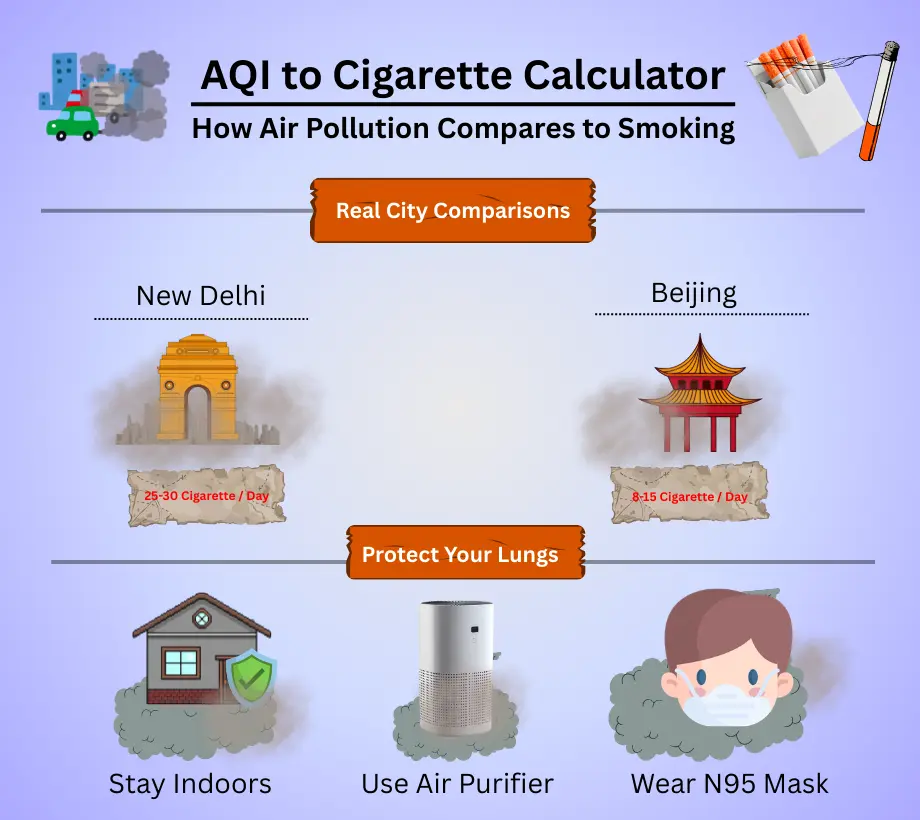
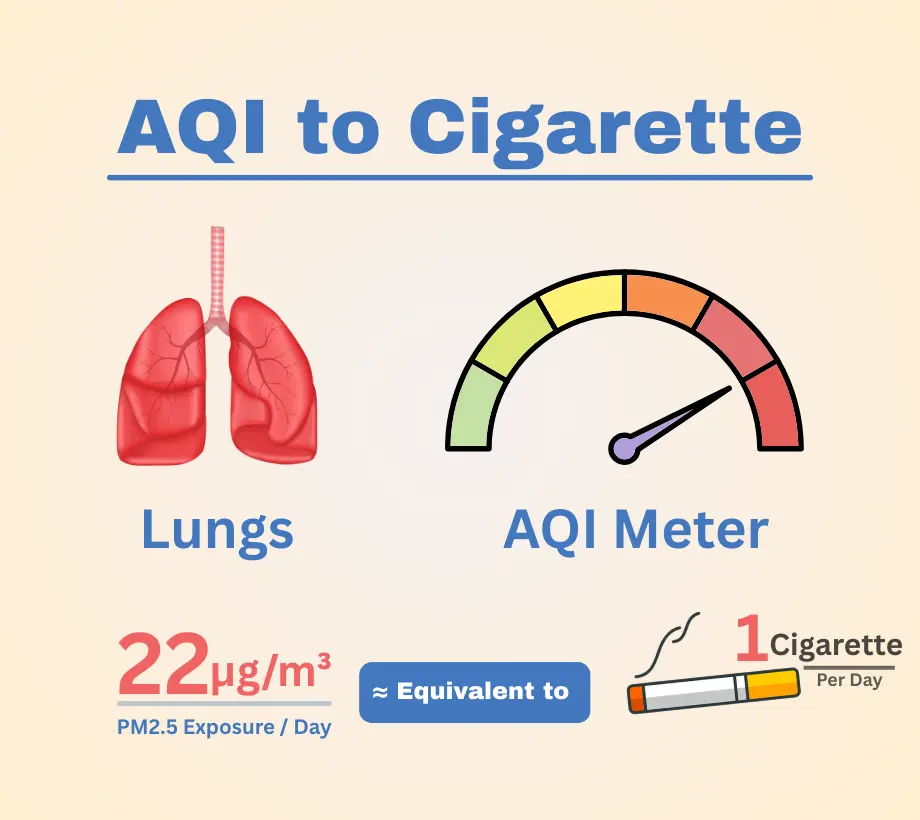
Currently, air pollution is considered one of the biggest environmental issues that has severe consequences for human health. However, it is not easy for everyone to comprehend the real harm that can be done by inhaling air filled with various pollutants. Air quality indexes (AQI), for example, are often hard to perceive for most people and to link to their everyday lives. The AQI to Cigarette Calculator serves as an effective solution to this problem.
This tool provides the equivalent number of cigarettes that represent the level of air pollution. It is necessary to note that even though it does not mean that the person is actually smoking the amount of cigarettes specified by the calculator, it gives a clear idea about the possible health consequences of breathing polluted air. In this paper, we will discuss this tool and explain how it can be used.
Meaning of Air Quality Index
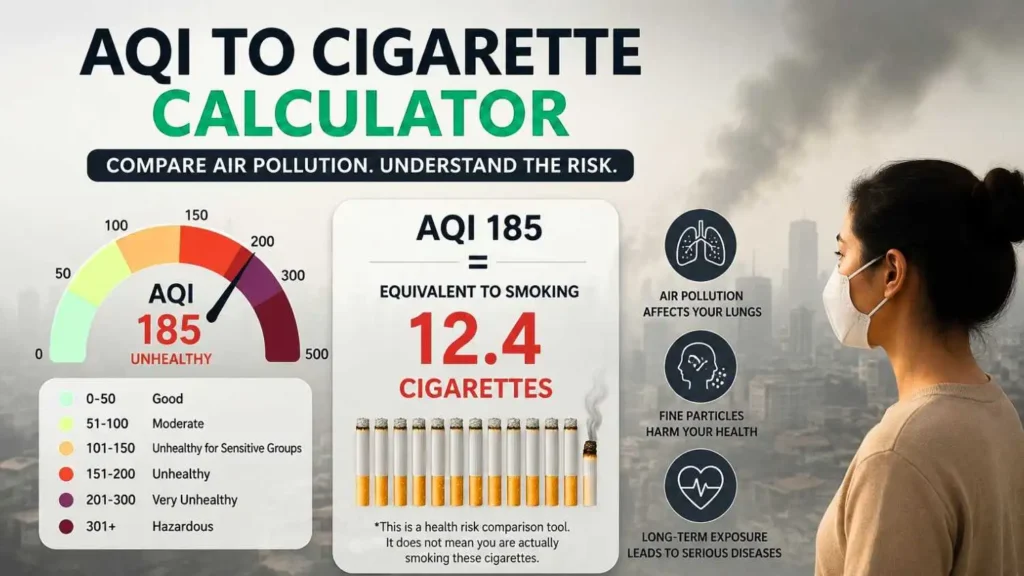
The Air Quality Index (AQI) refers to a standard numerical scale that measures the level of air quality and possible impacts on your body. The AQI ranges between 0 and 500, where higher values mean that the air is becoming dirty. In order to simplify this process of reading the index, different values are classified depending on possible health hazards associated with certain readings.
The air is referred to as “good” when the AQI falls within the 0-50 scale, indicating that it is perfectly clean for all people. “Moderate” air is characterized by an index of 51-100, which means that while being acceptable for most individuals, it may be harmful to some sensitive people. The “Unhealthy for Sensitive Groups” label is given to air quality ranging between 101 and 200.
Values from 201 to 300 are categorized as “unhealthy,” a condition at which members of the general population may start facing health problems. AQI values from 301 to 400 are referred to as “very unhealthy,” which indicates severe health effects. Similarly, AQI values from 401 to 500 are referred to as “hazardous,” which signifies extremely poor air quality and poses a serious health hazard to all populations.
The AQI is computed using the concentration values of different air pollutants, including particulate matter smaller than 2.5 microns (PM2.5), particulate matter smaller than 10 microns (PM10), carbon monoxide, sulfur dioxide, nitrogen dioxide, and ozone. Among all these, PM2.5 is regarded as the most dangerous because its small particles have the ability to travel deep into the lungs and enter the bloodstream.
Why AQI Tool Matters
It is difficult to give attention to air pollution since it cannot be seen, but when it is measured against a clear health risk like cigarettes, it suddenly takes on new meaning. AQI to cigarette calculator comes in handy in this regard because it makes it possible to relate air pollution statistics to a commonly known phenomenon. The conversion of AQI data into the number of cigarettes smoked by individuals will allow everyone to better grasp how serious the situation is.
Furthermore, it will create awareness about the risks associated with air pollution and make people realize that they need to pay more attention to this problem. Once this happens, people are bound to implement preventive measures since they might be exposed to an equivalent amount of cigarettes daily. In other words, it will make it much easier for everyone to recognize the problem. This is why this tool will definitely prove helpful to the residents of urban centers.
Conclusion
The AQI to Cigarette Calculator does not just serve as a converter but rather as an effective mechanism to fully comprehend how bad air pollution is for your well-being. By making AQI numbers understandable through conversion into something more familiar, like cigarette smoking, it reveals the danger behind them. The correlation might be inaccurate, but it is certainly an effective approach to alerting people and motivating them to make better decisions concerning their health.
In a contemporary era when air pollution is becoming increasingly common, such mechanisms are highly valuable. With regular monitoring of the AQI level and using the mentioned calculator, you have a chance to protect yourself from exposure to polluted air and, thus, avoid any negative health consequences.
FAQ’s
Q1. Can the indoor air also be calculated through this tool?
If the AQI and PM2.5 levels indoors are known (through an air quality monitoring device), then that too can be calculated by this calculator.
Q2. Is there any difference between AQI to cigarette calculators?
No, every calculator works on its own algorithm. Therefore, the results may differ from one another.
Q3. Can the use of this tool benefit my health?
Not directly, but indirectly, yes. It helps you in realizing the harmful effects of the polluted air on your health, which ultimately prompts you to protect yourself against it.